
What is Idiot-Proof Fall Lawn Renovation?
Lawn renovations for cool-season grasses are the most successful in the fall. It’s important to watch the calendar and follow these ten steps for fall lawn seeding. When overseeding and renovating your lawn, timing is everything, and the earlier, the better for maximum root development to ensure winter survival. Cool-season grass seed sown in the fall will germinate quicker than grass seed sown the next spring. Warm soils, short days, cool nights, and the welcome rains of September promise lower water bills for fall renovations.
Why Overseed in the Fall?
Overseeding is crucial for maintaining a healthy and lush lawn, particularly during the fall season. Fall provides optimal conditions for seed germination and establishment, as the soil is warm and moisture levels are relatively consistent. By overseeding your lawn, you can fill in thin areas, improve the overall density of grass, and enhance the resilience of your turf against pests, diseases, and environmental stressors.
10 Idiot Proof Steps to Overseeding Your Lawn This Fall
1. Measuring Your Lawn is Important
The first step to any lawn renovation is to measure your lawn. Measuring the size of your lawn is important for calculating the right amount of grass seed and fertilizer. A simple way to measure is to walk the perimeter, counting your steps. An average pace is about three feet. Multiply length x width and write it down.


2. Choosing the Right Seed
The next step is to figure out what kind of grass you have growing in your yard or what type of grass you’d like to grow. Here in the mid-west, cool-season grasses perform the best and stay green for the most prolonged period. The best grass seeds for overseeding include our Blue Wave bluegrass and Heat Wave fescue, which have excellent germination rates.
How Much Seed to Buy for Overseeding
Seeding rates are recommended in pounds (of seed) per 1,000 square feet. At Grass Pad, grass seed is sold by the pound. You only buy what you need. Seeding rates are determined by the type of seed you choose and evaluating the current state of your lawn. Grass types like fescues and perennial ryegrass are larger and, on average, have about 240,000 seeds per pound. Kentucky bluegrass is a much smaller seed and, on average, has 1.4 million seeds per pound. Fescue and perennial ryegrass seeds are five times larger than bluegrass. Therefore, fescue and ryegrass require more pounds per 1,000 square feet to get the same coverage as bluegrass seed.
Find Recommended Seeding Rates by Grass Type: Grass Pad Seed
Adjusting for overseeding, use a light overseeding rate when your lawn looks great with few bare areas. Use a heavy overseeding rate if most of your lawn is bare. It’s a good idea to round up the amount of seed you purchase to ensure you have enough to cover the area adequately. Come to the Grass Pad and talk to our green team seed experts, who will help you determine your ideal seeding rate and how many pounds you’ll need for your lawn. Bring your measurements!
All Grass Seed is Not the Same
Grass Pad acquires only the best quality grass seed for the midwest with the best performance. Over the last 60 years, our grass seed buyers have developed a reputation in the industry for being the most demanding for seed quality and performance. If you choose to buy seed from other sources, read the label and look for things like the amount of weed seed, other crops, and inert matter. To learn more about the differences in grass seeds, come on down to the Grass Pad and speak to our green team of grass experts.
See Related: Uncle’s Idiot-Proof Grass Seed Buyers Guide
3. How Low to Mow before Overseeding
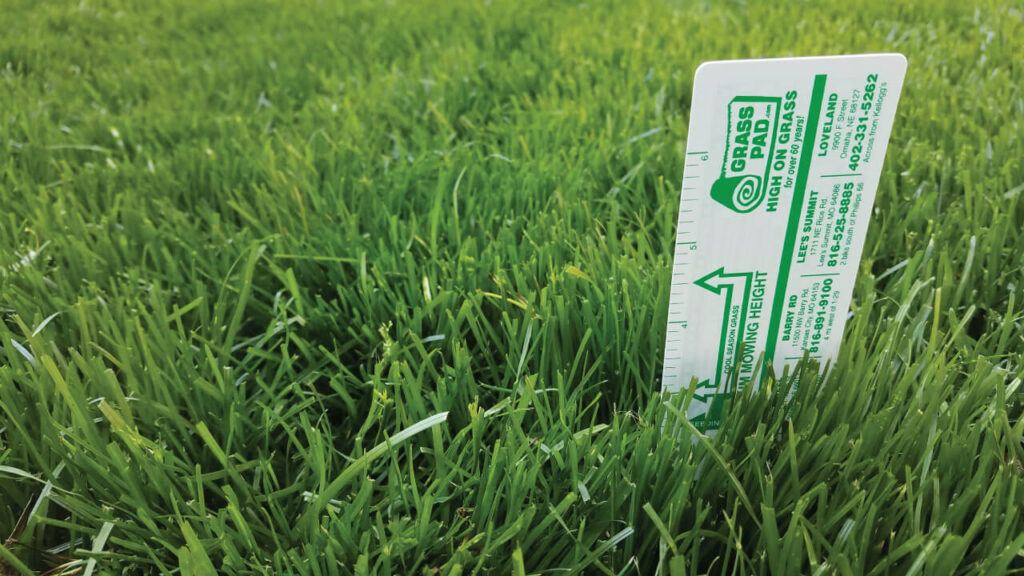
When you are ready to start overseeding, mow the lawn 1 or 2 notches lower, careful not to scalp the lawn. For a fescue or bluegrass lawn, this is about 2.5-3″ tall. Remove any debris from the yard, including any grass clippings. Grass seed needs contact with the soil, so remove anything from the lawn that’s in the way. (Bagging your grass clippings will help to remove debris.)


4. Roughen Up Bare Spots in the Lawn
Rough the surface of the soil giving special attention to bare spots. (For large areas, verticutting greatly improves your seed-to-soil contact but is not required for good fall seed germination. Soil should be moist, not wet when verticutting.) A metal rake or a Garden Weasel scratches the surface well. Don’t dig too deep – you need to rough up the top layer of soil to help the grass seed make better contact.
5. How Much Seed to Cover Bare Spots
The next step is spreading grass seed over the entire area using a rotary or hand-cranked “spinner” type spreader. Special attention should be given to spots where the ground is bare. Extra seeds may be applied by hand to these spots. This photo illustrates how the bare ground should look after the seed is applied.


6. Feed the Lawn
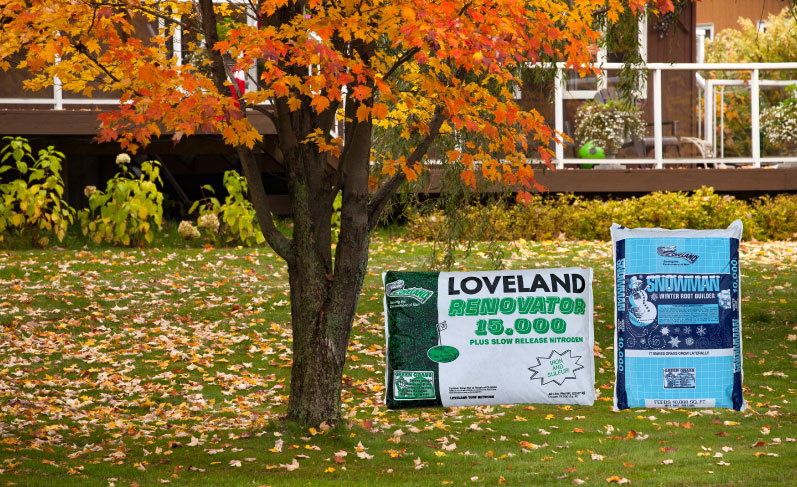
Apply Loveland Golf Course Starter at a fall rate of 6 to 10 lbs. per 1,000 sq.ft. or Renovator at a fall rate of 3 to 5 lbs. per 1,000 sq.ft. Healthy turf needs to be fed regularly. In a low nutrition environment, weeds prosper. In high nutrition, grass will prosper. Turfgrass will also recover from summer stress more quickly when using Golf Course Starter or Renovator at the above rates. They encourage root regeneration, bring rapid green-up and store energy reserves.
7. Cover the Bare Spots
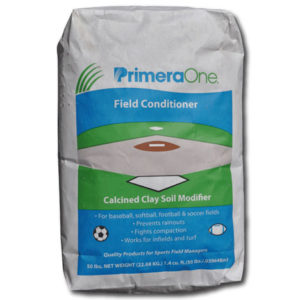
Grass seed is less likely to grow if it is not covered, so apply a light mulch of sphagnum peat or Primera Sports Field Conditioner as a grass seed cover. The sphagnum peat moss or Primera Sports Field Conditioner will both help keep the moisture near the grass seed, and keep the seed from blowing away. About an 1/8″ of cover works great – you shouldn’t be able to see the grass seed once it’s covered.
Top soil, black peat or straw contain noxious weed seeds and should never be used as a seed cover.
8. How to Water New Grass Seed
The ground needs to stay consistently moist for the grass seed to germinate. Continue watering lightly so the soil does not become hard or baked. How often to water grass seed depends on the weather. On hot and windy days, you’ll need to water several times a day. If you keep the ground consistently moist, you should see baby grass popping up in 7-10 days. If you do not see any germination in that timeframe, you may not be watering often enough, so increase your watering frequency.
9. When to Start Mowing New Grass
Continue your normal mowing schedule and when the grass reaches a height of 3 to 4 inches. Mow to a height of 3 inches with a sharp mower blade when the grass is not wet. Avoid making aggressive turns that may cause damage in newly repaired areas. Mowers moving straight across repaired areas should have minimal effect. Continue to mow your lawn as needed during the season.

10. When to Feed Your Lawn Again!
Four weeks after the initial application, apply a second application of Golf Course Starter or Renovator fertilizer at the same fall rate. This booster shot of fertilizer has been formulated from over 60 years of experience on our sod farms. Our high nitrogen with potassium formulations are designed to encourage root building, cold hardiness, disease resistance, and wear tolerance in our sod fields and will work in your backyard.

11. Turn It Up To 11! Snowman Winter Root Builder
Apply Loveland Snowman to the lawn in late October through December before the grass turns winter brown. Uncle’s winter root builder with lower nitrogen plus elevated phosphorous and potassium formulation specifically for late fall application on lawns.
New and established grass plants store food reserves to help resist winter injury, fight turf disease and stimulate grass root growth. After sixty years of research and development in our sod production, we can tell you that using Snowman will be the difference between having a good lawn and a Hall of Fame Lawn.
Improve winter color and boost spring green-up without stimulating excessive shoot growth, allowing grass plants to maintain energy reserves. Timing is important; the ideal application window is from Halloween to Thanksgiving before the ground has frozen.
Subscribe
"*" indicates required fields